Posts

Showing posts with the label Energy

MOX Fuel at Ikata in Ehime Prefecture, Shikoku

I was hoping this would not happen. Protesters are also outside the plant. They read out a statement protesting the insertion of nuclear fuel into the No.3 unit. The statement said the system for transmitting electricity to the plant cannot withstand a powerful earthquake and the plant's safety cannot be guaranteed. A stable power supply is needed to maintain the cooling of the reactor. One of the protesters said that in view of the powerful temblors that struck Kumamoto, the operator should not rush the process of inserting fuel into the reactor. NHK World: Fuel loading begins at Ikata No.3 nuclear reactor Workers have begun loading nuclear fuel into a reactor at the Ikata power plant in western Japan. The operator plans to restart the reactor in late July. They started removing units of fuel rods from a pool on Friday, and placed them into the No.3 reactor one at a time. Sixteen of the 157 units of fuel rods are the type of fuel called MOX, which is a mi...

Kyoto Journal 83: Food Issue (With An Interview With Me!)

Image
Just published is the 83rd issue of KJ, as it is known among fans. I have some old print issues that I hope will become really valuable at some point (just kidding) from when I first lived in Japan 1988-1993. This time, KJ is all digital, the topic is food, and what could be more timely? Japan, Asia and the world face a number of huge challenges, including food safety, food security, seed/genetic/biodiversity concerns, not to speak of water and agro-chemical/fertilizer related concerns. Climate change is already causing havoc. Fuel? It will not stay cheap forever, and then how do we keep supermarkets and convenience stores up-to-the-last-minute with the latest "fresh" goods? Fertilizers? Not up for grabs forever, either. Add to that land ownership legal battles, and the fact that in many places, farmers are aging and not enough young people are prepared to take over. Plus trade related issues like WTO/TPP and a "spaghetti bowl" of bilateral trade agreements ...

Eco Links For December 2014-January 2015

Image
I could probably do better, but here are a few links that caught my eye recently. Mother Jones writer Tom Philpott provides a lot of convincing arguments and links that These Ubiquitous Chemicals May Be Making Us Stupid Kids exposed to the highest levels of two common phthalates in the womb had an IQ score, on average, more than six points lower than children exposed at the lowest levels. Do avoid. But do read. The Asahi gives us a hint that should be made more generally available; clearly, this is not advice "to Japanese men" but to all of us. Is this really the level to what newspaper editing has been reduced to? Anyway, important study. Scientists to Japanese men: Eat your veggies, reduce stomach cancer risk January 05, 2015 THE ASAHI SHIMBUN Japanese men can reduce their risk of developing lower stomach cancer simply by eating a lot of vegetables, researchers at the National Cancer Center and other institutions found. ...

FY 2015 Budget: More Money For Solar, Renewable Energy

Image
More money to efforts to get Japan more firmly on the track towards renewable energy? Green Gift is a project I really like. It encourages grandparents to give money to their children/grandchildren for use of renewable energy-based power. Specifically, when grandparents give money to their children/grandchildren for the installation of solar power generation facilities or fuel cell-based co-generation systems, such money is exempted from gift tax. I believe this is the first such project in the world. Green Gift means grandparents can make a gift that contributes to the global environment while their children/grandchildren can reduce utility costs and gain an income from selling solar electricity. Also, the installation of low-carbon-emission facilities and renovations for adding energy-saving facilities are expected to create business opportunities for local device/parts makers and contractors, energize local economies and revitalize local communities. This system...

Japan, China Officials Unite on Environmental Measures?

I always knew this was possible, thus Kurashi, for 10 years and counting. Hoping 2015 can bring some more sense into affairs between the great countries in this region. Small planet, huge population issues, got to start caring about more important concerns.  Says NHK World: Japan, China discuss environment in Beijing Asia Dec. 28, 2014 Delegates from Japan and China have held their first forum in 2 years to discuss environmental problems. About 500 economy ministry and industry officials of the 2 countries took part in Sunday's event in Beijing. The vice chairman of China's National Development and Reform Commission, Xie Zhenhua, said China considers natural-resource and environmental problems as significant and that Japan has advanced technologies and experience in this field. He said China wants to deepen cooperation with Japan in the energy-conservation and environmental sectors, and that this would lead to improved bilateral tie...

Eco Links For October 2014

Image
Inspired by this and more , tongue firmly in cheek... Tokyo, Japan -- Power was restored in most of Japan on Sunday, a day after the impoverished, energy-starved nation was plunged into a nationwide blackout when a transmission line from well, nowhere, failed, officials said. The blackout was the country's worst since a 2007 cyclone knocked out the national grid for several hours, and again exposed inefficient and dated infrastructure that has held back development in the North East Asian nation. Electricity was cut across Japan at around noon Saturday after the transmission line experienced a "technical glitch" that led to a cascade of failures throughout the national power grid, with power plants and substations shutting down. After an evening spent in the dark, most of the residents of Tokyo, the capital of more than 10 million people, got electricity back on by 1 a.m. Sunda...

The Japan Toilet Paper Myth, And Some Realities

Image
September 1 each year is a day when Japan remembers its many earthquakes and other emergencies. Events are held to train people how to use fire extinguishers and other equipment. This year, before that date, the Ministry of Economy, Trade & Industry mentioned that as a general precaution, households ought to stock up on, say 15 rolls of toilet paper rolls per month, in advance. Not a very unreasonable piece of advice. Without mentioning the focus on September 1, many foreign news media carried all kinds of headlines about this. Be that as it may. Expecting young journalists to understand Japan is like - well - it's the old hands I'm more worried about. Also, back in 1973, scare stories in Japanese media about people buying two years worth of the rolls triggered others to hoard as well. Media bears a huge responsibility in times like these. Reports about any event of mass buying will of course encourage others to engage in - mass buying. They know that back during th...

ISEP: Sustainable Development In Rural Japan

Image
Institute for Sustainable Energy Policies, founded in 2000, showing how rural Japan is doing so much better than big cities. Institute for Sustainable Energy Policies (ISEP) aims to realize sustainable energy society based on four pillars: (1) Efficient energy system based on renewable energy, (2) Fair distribution of risk/benefit regarding to energy use, (3) Transparent and participatory decision making regarding to energy policy, (4) Decentralized and autonomous individuals and communities, and has engaged in the policy research, advocacy and information dissemination. And after 3.11, in the course of fundamental reconsideration of energy policy in Japan, we have developed the transformative strategies and concrete measures. Tokyo, Osaka, and other large cities are ranking really low on this ratio of renewable energy share... More about ISEP and its global network “Renewables Japan Status Report 2014”, Executive Summary (English version) Producer: Institute for ...

Nobel Prize - Blinkar Blå

Image
Curiosity about the Nobel Prize in Physics that went to three Japanese researchers who developed the blue light emitting diodes (LED) that has ushered in a revolution in electricity savings: Back in 1981, a Swedish band, Adolphson & Falk, had a hit with a tune called Blinkar Blå, recorded with Greg Fitzpatrick from the US who was selling novel Japanese synthesizers by Casio and Yamaha in Stockholm. The lyrics paint a lonely picture of a man sitting by his controls, maybe in a space ship, or at night inside a nuclear power plant, and as long as the controls are "flashing blue" all is OK. He trusts his computers, but... Back then, of course, there were no such blue LED lights, so the lyrics had a certain sense of futurism...And uncertainty. Wikipedia has more about the song: Blinkar blå (Flashing blue) På panelen ser jag lamporna som lyser. Processens steg står under min kontroll. Jag håller ögonen på datorns analyser. Här har ovissheten spelat ut sin roll. K...

For Biodiversity...

Image
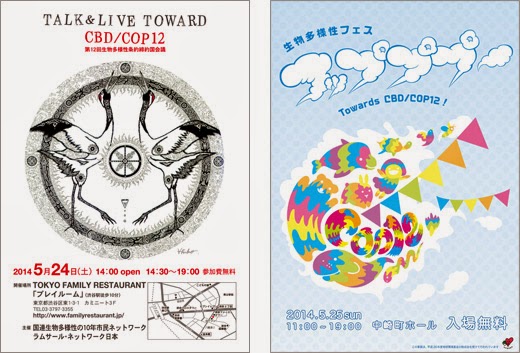
...work obligations and long held convictions will take me to Pyongchang, South Korea, for the UN Convention of Biological Diversity conference. Remember Nagoya, 2010 ? I feel very fortunate to be able to participate in events like this. Since the Rio Summit in 1992, it was clear that climate change and biodiversity where among the most pressing issues facing our planet. We need sunshine and rain and food (seeds) and rain and then some certain comforts. Energy issues - another factor, but the global community never managed to create conventions for that, thus the uncertainty. Imagine - a UN convention for oil. Or a UN convention for energy. Didn't happen. I have kept working on food safety issues, trying to educate people about seed issue, and the importance of organic farming, and avoiding the massive amounts of antibiotics used for the animals people eat. Plus I try to tell everyone that cares to listen to avoid artificial additives, or colourings, if possible. But ...

Eco Links For July, 2014

Image
I went for a walk and watched fireflies near a temple where I live. Amazing creatures. Got a lesson in bioluminescence from Pandabonium, too, via National Geographics. There is a lot I do not know. I like how my town is not exploiting this site for tourism. July - hot and humid. Japan still has no nuclear reactors online. Do people in other parts of the world even think about this? Can we get some support, please? Seems a small town in Tochigi near major tourist spot Nikko, where the Tokugawa shoguns have their final resting place, will be selected to permanently store radioactive waste from the Fukushima nuclear disaster. "Permanently" is a pretty serious word when it comes to nuclear waste. Not sure why they didn't put it in Fukushima. Expect Narita-style protests? The Mainichi: Tochigi town favored as permanent radioactive waste storage site Shioya Mayor Kasuhisa Mikata, right, expresses his disappointment ...