Posts

Showing posts with the label automobiles

"Clean Diesel" Scandal Hits Japan?

Image
If you follow car news, or wonder about the future of mobility - and/or care about the air we breathe, well, then you must have noticed that Volkswagen was caught on September 3 by the biggest story ever. Diesel cars use engines that are pretty powerful on less fuel compared to gasoline, but they also have more emissions of CO2 and worse, the Nitrogen compounds known as NOx. These combine on hot summer days to form smog and ozone and really bad stuff that will actually kill people. So for a long time, diesel has had a bad rap, so to speak. Then car manufacturers tried to remedy that by introducing all kinds of systems to clean the exhaust. Except, due to the terrific work by a small NGO in the US with just a staff of 25 or so people, it was revealed that Volkswagen had put a computer program algorithm in its engines, that could detect if the car was being tested or not. In other words, if a test was going on, switch on the system to clean up the exhaust, and emit less NOx and o...

Japan Ranking, Toyota Number One?

Image
We all like to compare, and here is how Bloomberg got Japan at 4th place among the world's most innovative countries. 4. Japan Japan ranked fourth in Bloomberg's Global Innovation Index. Here is how the country ranked in the determining factors: R&D intensity: 5th Productivity: 14th High-tech density: 8th Researcher concentration: 9th Manufacturing capability: 6th Tertiary efficiency: 30th Patent activity: 3rd I would be much more impressed if Bloomberg added an energy capability to its index. And why not other factors related to environmental protection? We all held our breaths, and sorry to say, Toyota once again is the world's number one car manufacturer . Too bad, I would say, as Japan has no idea how to supply the gasoline to promote a car-owning culture. I know, they are awfully fuel efficient and they do the Prius and all of that, but come on, we are facing a future with massive emissions of carbon dioxide, and other man-made gasses a...

Japan: Eco-friendly Projects To Get Subsidies

Image
From NHK: The Japanese government will provide subsidies to 153 corporate investment projects that aim to contribute to reducing carbon dioxide emissions in the country. As part of its emergency economic stimulus measures compiled last September, the government will subsidize domestic investment projects by up to 180 million dollars each. The assistance will target such projects as the construction of a factory that will manufacture lithium-ion batteries for electric cars. The Economy, Trade and Industry Ministry has selected 153 projects as recipients of the subsidies from 285 applications. The selected projects include a battery maker's program to build a new plant and an electronics company's plan to boost production of semiconductors. The government earmarked a budget worth about 1.3 billion dollars for such subsidies while the amount of such corporate investment projects totals about 6.4 billion dollars. Officials say the projects are expected to create about 95,000 jobs a...

Nissan Leaf In The News In Europe: Car Of The Year, Post Peak

Image
I don't own a car and do not plan to buy one, especially considering the economic situation we face, which is really a global bubble bust, and if you are lucky, you live in a country that still has a banking system. I take the trains and walk a lot. If I was in great need of a car, what would I do? (Again, not a scenario that is on the radar) In the midst of all the news from Europe about huge risks that the Euro Zone may collapse, and what will the Germans do after the Irish bailout, with worries about Spain (and others), how is this for some "good" news: The Telegraph: Nissan Leaf wins Car of the Year Yup. The world's first mass produced battery electric car wins the premier European award. That's how serious things have gotten. No more SUVs, Hummers (and Volvo, now owned by a Chinese upstart, came 6th in the rankings). I find it ironic that mass media is still so caught up in the car craze. I understand that a lot of people live in places where they really, rea...

MSN News In Japan - Ads Or Just Business As Usual?

Image
If you ever read MSN News in Japanese, which I do, you may be used to having to sift through commercials posing as editorial material. Or is it the other way around? Their summer campaign for hybrid cars takes the cake. Now, I enjoy reading about two girls driving from Asakusa, Tokyo, to Izu (and then apparently they will travel to Hokkaido) but shouldn't it be made much more clear that this is an ad? The young girls pose in bikinis for both Toyota Prius and Honda CR-Z (from July 23) but from what I can gather, this is not really a MSN News segment. So what is it? OK, it is very hot and maybe someone decided that this was the best they could do to combat global warming, let's get out of Tokyo, summer in the city, 2010-style ;) Click on the image to enlarge Sigh - have we learnt nothing since 1957, when Vance Packard published his book called The Hidden Persuaders , about how images were being manipulated in advertising to induce desire for products or ideas in a subliminal fas...

Car Engine Idling: Stop Wasting Fossile Fuels!

Image
Wasting fossile fuels seems like an increasingly important issue to tackle. I have mentioned how much I dislike drivers who leave their car engines on, while they do other things, including shopping or sleeping. It is a common practice in Japan, even though it is technically illegal in many places. Even large trucks and tour buses just park and keep idling, apparently unaware of the air pollution and noise. Kids especially are at risk and allergies are on the increase. The fact that we are running out of oil on this fragile planet also seems to not bother these drivers, and they need to understand how their ignorance is contributing to climate change. I often take the local bus in Tokyo, and many bus drivers turn off the engine as they stop at red lights. I have noticed that many transportation companies also encourage their drivers to stop the engine when unloading goods. My postman sometimes stops his Cub bike when he has a lot of letters to deliver, but Japan Post doesn't seem t...

Lithium In The News, Little Do We Know

Image
Toyota and Honda would not be selling a lot of hybrid cars if they didn't have enough lithium for the rechargable batteries needed. Your cell phone or your brand new iPad would not work without it. This little known mineral is rare, and we know little of how it is mined for use in all kinds of applications (known as "eco" here in Japan). Is it not rather telling that most people have no idea at all where the important metals and minerals are coming from? Who is keeping such information from the consumers? On his visit to Tokyo, Afghan President Hamid Karzai said this week that Japan takes priority over other nations when it comes to mining his country's vast mineral deposits. Karzai made his proclamation during a five-day visit to Japan. Grist has more, and Huffington Post even quoted our very own Japan Times : "Morally, Afghanistan should give access as a priority to those countries that have helped Afghanistan massively in the past few years," he said...

Open Thread: Toyota Recall

If you have any opinions about the recent news about Toyota's recall, here is your chance to say what you think.

Eco Points For Chrysler Jeep? You Must Be Joking

Image
There are three ways to blog about this piece of news: LOL, Jeep Patriot will be the first American car to qualify for Japan's eco point system. "Improvements" to the engine have "improved" its fuel efficiency from 10 kilometers to 10.6 kilometers per liter (25.0 mpg), according to the Mainichi . That's hardly an "improvement" ladies and gentlemen. The Japanese government introduced the subsidy program for eco-cars in June last year, in which up to 250,000 yen will be provided for the purchase of a vehicle with a minimum required gas mileage. However, as most American automakers do not acquire product model approval in Japan, the government had decided to exclude U.S. cars from the program, due to the lack of reliable mileage data required for the screening. Meanwhile, the Toyota Prius (44 mpg) or Honda's Insight (38 mpg) get, on average, almost twice the fuel efficiency. Jeep, an eco car? No way. Source: Consumers Report: Fuel Economy Realit...

US Car Makers Lie About Japan's Cash For Clunkers Scheme

Blatant lie exposed: The US car industry must really be in deep trouble when they claim that Japan's program to help car owners change their old vehicle to a newer one is unfair, claiming that the program makes "the vast majority of imports ineligible for the program's significant tax cut benefit, regardless of the vehicle's fuel efficiency." I'm no fan of cars but the rules here do not in any way discriminate against foreign cars. So this is just another ruse from Detroit, which is now going around the internet, making ordinary Americans angry and risking their high blood pressure even more than, say Tiger Woods or Medicare legislation. Come on, read the rules, there is not a word that says "Japanese cars only". All old cars are eligible, and all new ones apply, as long as you buy one that is more fuel efficient. The American government has a trade representative, the USTR, an office that I don't really understand the meaning of, except that the...

Vintage Japan: Toyopet

Image
Toyota has been making cars for over 70 years, and by 1936, the Nagoya-based company was making models that were strong and solid enough for the road conditions of the time. The Toyota AA was produced from 1936 to 1941: 1 engine (3,4 liters / 65 hp) with 353 units produced. It was Toyota Motor's first passenger car, adopting "the popular streamline style, possessed an ideally balanced load on the front wheel, and offered a superior ride which placed it above many foreign cars in terms of comfort," according to the Toyota Museum website, which claims that it was an "advanced automobile." Moreover, Toyota's production know-how was developed completely in-house, while Nissan Motor Company acquired designs for large passenger cars and production facilities from the Graham Paige Corporation of the United States (Others claim the early Toyota models were Cadillac knock-offs). During WW2, Toyota was involved in truck production for Japan's Imperial Army...

Nikkei Eco Japan: Translating The Latest News

Image
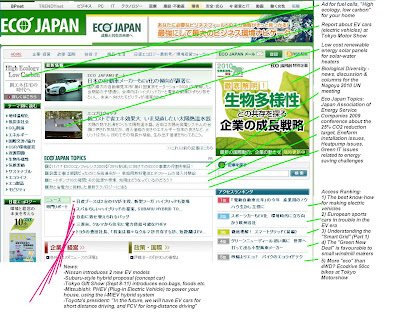
This is something I wanted to do for a long time: a quick rundown on what's considered as news at Japan's leading news website for eco topics. Nikkei is the big news paper devoted to economic issues, and their Eco Japan website reflects some of that focus. It's not going to give you the small-scale, happy-go-lucky news or information about grass-root events that you usually see here on Kurashi. Yet, I think it highlights what corporate Japan Inc. is thinking these days, to a large degree. Tech-On! has more stories in English. Plus, of course, Japan Inc. has some 70% of the patents to back up their claim to the No 1 spot: The Japan Patent Office conducted a survey on trends in global patent applications related to electric vehicles (EVs) and other "electric propulsion vehicles" and announced that about 70% of the applications were filed by Japanese applicants. Electric propulsion vehicles include EVs, hybrid electric vehicles (HEVs) and fuel cell vehicles (FCVs)...

Toyota Hybrid Patent Problems In The US

Image
Toyota has introduced the most advanced hybrid technology and sold some 2 million of its Prius cars. Yet, in the United States, there are patent issues that could stop the sales. Yup, there are people in the US who are trying to argue that hybrid cars from Japan should not be sold in the US. I first mentioned hybrids in a post way back in May, 2005, quoting Walt Whitman. Toyota introduced hybrid engines in 1997. From their annual report that year: We welcome healthy disagreements in research and development. Spirited debate and competition are the essence of fertile R&D. In the words of the poet Walt Whitman, "Do I contradict myself? Very well then....I contradict myself; I am large....I contain multitudes." The pioneer at Toyota who developed the hybrid engine is Dr Takehisa Yaegashi . Yaegashi-sensei is not that well known, but he won a prestigious award for "Best engine of the year" at the Engine Expo 2004, Stuttgart. In 2002 he was co-recipient of the Ameri...

Asahi: DPJ Policies Would Raise Annual CO2 Emissions

The Research Institute for Local Initiative of Environmental Policies is unhappy with some of the ideas put forward by the Democratic Party of Japan: A pledge by the main opposition party to abolish expressway tolls and special car taxes would "raise the volume of road traffic and result in an annual increase of 9.8 million tons in carbon dioxide (CO2) emissions." Prime Minister Taro Aso, who is not really known for his treehugging tendencies, criticized DPJ leader Yukio Hatoyama, saying the opposition party's manifesto "would increase oil consumption and have a negative impact on the environment." The election is on August 30, and I suppose DPJ could still change its mind about this idiotic stance. I don't plan to comment a lot on the election, but this was too important to ignore. Asahi: DPJ policies would raise annual CO2 emissions, think tank says In its policy platform for the Aug. 30 Lower House election, the Democratic Party of Japan pledged to aboli...

Japan Hoping That GM Chapter 11 Will Not Be The End Of The World

Asahi has a brief but good analysis of the sentiment here in Japan as General Motors went to the courts filing for bankruptcy protection. Chrysler has already been rescued by Fiat, the Italian car maker, while Ford remains stable. 1) Toyota has reached a basic agreement with GM to continue New United Motor Manufacturing Inc., a joint venture in Fremont, California, established in 1984. 2) Suzuki Chairman Osamu Suzuki said CAMI Automotive Inc., a joint venture with GM in Ontario, Canada, will play a central role in GM's reconstruction. 3) A top Isuzu executive said the company's relationship with GM would continue because the truck business had been profitable everywhere except in the United States. Asahi: Firms brace for GM bankruptcy A lot more is going on behind the scenes today (Monday), as you may expect. This is not just about selling automobiles to individuals who really can't afford it using no-money-down incentives: "Parts suppliers, meanwhile, are trying to se...

Honda Insight: First Hybrid Ever To Top The List Of Best-Selling Cars In Japan

12 years ago, Toyota introduced a revolutionary car, the Prius, on the market. It was a "hybrid" meaning its engine could switch between gas and electric drive modes. Now, the new Honda Insight is the best-selling car in Japan for the month of April. It is the first time ever that a hybrid car tops the list here in Japan (or anywhere in the world). Other car makers have been much slower to introduce hybrid cars, and even Ford had to licence Toyota's technology in order to get its first hybrids on the road. I don't own a car, and I don't plan to buy one (I love trains) but I do think we are witnessing a paradigm shift away from gas-guzzling automobiles, to an era where mobility means we only use energy resources as efficiently as possible. I'm sorry to say that U.S. -owned car makers Volvo and SAAB are so far from this race that they frankly deserve to go under, unless they can start to make cars with fuel efficiency that match the hybrids - and why not? In Sw...

Sayonara, SAAB

Saab Automobile AB on Friday filed for court protection from creditors, becoming the first GM unit to fail: The move came after the Swedish government rejected GM's request for financial aid to Saab. Saab hopes to complete its rehabilitation into a company independent from GM through a court process in three months. Saab became a GM subsidiary in 2000 and has remained plagued with losses. Amid the global economic downturn, its auto sales in 2008 plunged 25 percent from the year before. Breitbart Lots of comments over at General Motors Inside News

Top Gear Grinds Into Reverse: Nissan GTR Vs. Shinkansen 700

Image
Neil Duckett uploaded two fun episodes of Top Gear, the car program that BBC broadcasts without any care for peak oil , CO2 emissions or other environmental issues that interest us here at Kurashi. As it were, Jeremy Clarkson got to race across Japan in a Nissan GT-R (that he clearly loved, breaking a lot of local speed laws, and as far as I know, got no ticket). His fellow BBC companions took public transit including the 700 Shinkansen . Isn't it rather absurd that in the event of the current energy crisis, BBC airs such a show, without a single reference to (cough) reality. More over at Treehugger: Top Gear: Fast, Sexy Car Vs. Shinkansen, A-Bike And Public Transportation As a good friend of mine kindly noted in an email earlier today: ...we have no time to convert one person at a time ("one light bulb at a time" as it is sometimes stated) in order to save the planet. Making fossil fuels cost a lot automatically causes people to change their behaviors. Perhaps organi...

NHK: Toyota To Cut Production By Half

Cars, anyone? No, I didn't think so. That's why I feel blogging about trains and other more environmentally friendly transportation options makes so much sense. We need investment in public transportation, not in fancy cars. Do you own a car? I do not. Are you worried yet? I am. Toyota Motors announced today that it plans to make half the number of vehicles it produced in 2008. Half. 50%. NHK World quotes industry sources, that say the company will slash production to around 9,000 vehicles a day in February and March at plants across Japan: The company already reduced production last month when it set a daily output for the 3 months until the end of March at 12,000 units. Toyota also planned a coordinated stoppage of operations at domestic plants for 11 days from February through March. But it may be forced to take a similar measure in April as well, as there is no sign of improvement in global car sales. Ladies and gentlemen, this is how Toyota, the worlds most sucessful au...

Eco-Products 2008: Asking Difficult Questions About Electric Cars

Image
I loved Eco-Products 2008 at Tokyo Big Sight. There was a lot to see, and a record number of visitors this year. Over 173,000 people compared to 164,000 in 2007. Clearly a trend! Over at Treehugger , I singled out Subaru's electric car, because of the "System Thinking" - a focus not only on the vehicle, but on where the electricity will be coming from. Subaru also showcased its 80/2.0 wind mills to power the products they plan to profit from. Great electric cars are indeed available today. The question is how people and nations will change the infrastructure to power them. If you are a Pokemon fan, you may have seen the early 1960s Subaru 360 convertible, a fun car that never made it very big in the US, after Consumer Reports called it unsafe. For the R1e and Stella electric cars, Subaru cites the 360 as an influence. I like that sense of humour, and the reminder that this is a company with small, strong roots. They think the all-electric vehicle could be available to c...