Posts

Showing posts with the label solar power

FY 2015 Budget: More Money For Solar, Renewable Energy

Image
More money to efforts to get Japan more firmly on the track towards renewable energy? Green Gift is a project I really like. It encourages grandparents to give money to their children/grandchildren for use of renewable energy-based power. Specifically, when grandparents give money to their children/grandchildren for the installation of solar power generation facilities or fuel cell-based co-generation systems, such money is exempted from gift tax. I believe this is the first such project in the world. Green Gift means grandparents can make a gift that contributes to the global environment while their children/grandchildren can reduce utility costs and gain an income from selling solar electricity. Also, the installation of low-carbon-emission facilities and renovations for adding energy-saving facilities are expected to create business opportunities for local device/parts makers and contractors, energize local economies and revitalize local communities. This system...

Eco Links For May, 2014

Image
Remember these guys that looked like they were trying to bolt from my refrigerator? I planted them and 4 months later, they have given a steady, daily harvest of tasty green peas! Thanks to some of you who have been sending links. The solar energy boom continues in Japan, according to Rudolf ten Hoedt in my new favourite city, Kagoshima. Well researched article published by Energy Post and others, pointing out that the boom is not without issues: For Japan, solar obviously has priority over wind power. 6.7 GW of solar capacity was approved in Japan for the feed-in-tariff (FIT) scheme in 2013. Almost half of this was utility-scale solar. This year, Japan is even expected to install over 10 GW of solar power, with more than half of this being utility-scale solar. The boom in utility scale solar got started by an FIT- program introduced in 2012 by the Japanese government. Under this program, regional utilities have to buy power from solar and other renewable energy producers...

Eco Links For March, 2014

Image
IPCC report warns that climate change could threaten food security, increase poverty and become an indirect cause of conflicts, says NHK World today as the Intergovernmental Panel on Climate Change meeting ends in Yokohama. At a press conference Monday, IPCC Chairman Rajendra Pachauri emphasized the need to take the predictions seriously and make efforts to address problems related to global warming. No one would be immune from the impact of global warming, he said. The report mentioned frequent surges in food prices that took place after IPCC published a similar report in 2007. It stated that abnormal weather that frequently struck main food-producing areas, including heat waves, droughts and floods, were a principal factor behind the sharp rises in food prices. The report said a 2 C increase in temperature would cause a decrease in the harvest of rice, wheat and corn in temperate and tropical regions. An increase of 4 C or more would deal a serious blow to each nation’s ...

Organic Festa In Kagoshima

Image
This organic food market event in Kagoshima City today Sunday Nov. 11 seems to good to pass over! I wish I could join. "Living with nature, playing with Earth" or something like that - is the slogan. The event is not just about food but also promoting renewable energy, using 100% solar for the concert and other activities on the stage. Enjoy! Organic Festa

Feed In Tariffs In Japan Vs Abroad Rather High?

Image
Just a quick comment here following the event on Sunday for Fresh Currents , the excellent work to try to combine and collate in English what is going on right now in Japan and the world regarding renewable energy. One of the questions raised to Eric Johnson, who edited Fresh Currents, was about Feed In Tariffs (FITs) that are very important to get people to invest in alternative energy, like solar, wind, geothermal. All kinds of local energy solutions - that can help get us off nuclear power, or rather away from the energy monopoly that supported nuclear power - are going to benefit from FITs. Impressive rates show Japan's commitment to a way forward... Yes, Japan's new law from July 2012 is rather generous and will provide 42 yen per kW/h (for solar) and that is good news. FIT levels for the UK , for example, are around 9-20 yen per kW/h for solar. A similar scheme for New York Long Island Power Authority will give users just 17.85 yen per kW/h for 20 years. For Germ...

Energy Independence?

Image
Returning to Japan, I have jetlag issues that remind me of how fragile we are in our human bodies. Mind over matter? Hardly. I bet politicians and other people who travel too much get a taste of this on a regular basis, thus they don't make so much sense when they appear in front of committees and conferences. That is no excuse for Mr. Romney, who pushed for his "energy independence by 2020" plan by "removing regulatory barriers to fossil fuel development in the United States, and increasing cooperation with fellow energy-producers Canada and Mexico." You guys out there that drive a car to work and think gasoline is already too dear, think again. There is no such thing as cheap oil, as consumption is increasing in China and India. And we are not finding new oil reserves to replace Saudi Arabia. What really struck me as weird was the chart that the Guy-Who-Wants-To-Be-Elected-Leader-Of-The-So-Called-Free-World used. Note how it says "Tight Oil...

I Almost Forgot: Feed In Tariffs From July 1 In Japan

Image
I wish they would come up with a better name than Feed In Tariffs, but ok, we got them, and that is good. It means we are now entering a new era for renewable energy. Hey, call it whatever you want, a lot of people are going to like this. FIT? No joke. Don't throw a fit! The system requires utilities to purchase all electricity generated through solar, wind, water and geothermal power, among other eco-friendly sources, at fixed rates for up to 20 years. The costs will be passed onto consumers. The government's generous tariff rates have created considerable interest in the sector, with companies rushing to build massive solar and other power plants based on renewable energies. Two large solar installations went online in Kyoto, Gunma, Niigata and Fukuoka prefectures the same day. Meanwhile, Kyocera Corp. plans to construct a 70-megawatt solar facility in Kagoshima Prefecture and is scheduled to establish a special company to oversee the project later this mon...

“Fresh Currents: Japan’s Flow from a Nuclear Past to a Renewable Future”

Image
From the good people over at Kyoto Journal an appeal to support the next issue, "Fresh Currents" by donating thru the indiegogo.com website: http://www.indiegogo.com/freshcurrents More than a year after the triple meltdown at Fukushima, Japan and the rest of the world continue to grapple with the short- and long-term consequences. The myth that nuclear power can deliver us from the long-term evils of fossil fuels has been shattered. Renewable energy, long dismissed as impractical, is being given serious reconsideration. Japan can and must take advantage of this opportunity to rethink and refocus its energy strategies.   In Kyoto, birthplace of the Kyoto Protocol, a dedicated group of reporters, writers, artists, editors, and photographers associated with Kyoto Journal ( www.kyotojournal.org ) is taking a fresh look at proven and innovative alternative technologies such as solar, wind, geothermal, mini-hydro, and biomass as well as the even greater number ...

Media Power, And Media Lies About Power

Image
As Japan heads into unknown territory, energy-wise speaking, expect mass media to sound all kinds of alarms as they are funded by the electricity companies and TEPCO in particular. David McNeill noted that "Japan's power-supply industry, collectively, is Japan's biggest advertiser, spending ¥88 billion (more than $1 billion) a year, according to the Nikkei Advertising Research Institute. Tepco's ¥24.4 billion alone is roughly half what a global firm as large as Toyota spends in a year." The Japan Times:  Fukushima lays bare Japanese media's ties to top Be that as it may, I'm always worried about the sanity of regular bloggers, and others who may get a little too upset and stressed-out about what they read with their morning coffee. Isn't it funny how "media" has the "power" to make us upset...? But of course what I'm really talking about is the fact that Japan now is running without a single nuclear reactor in servic...

Can Japan Phase Out Its Nuclear Reactors?

Image
I just thought I'd like to mention one thing from the Yokohama anti nuclear power conference on January 14-15 that I can't get out of my head. At one of the workshops, Swedish expert Göran Bryntse, PhD, who has led the anti-nuclear movement in Sweden for a long time, talked about how citizens can change the energy policy. First of all, he noted, energy efficiency is the best and cheapest alternative to nuclear power. For example, a country like Sweden can save up to one third of its energy consumption through heatpumps, more efficient engines, LED lights, and new whitegoods such as the latest refrigerators. In the case of Sweden, these measures would be able to replace 4 nuclear reactors, according to Dr Bryntse. Additionally, 6 more nuclear reactors can be replaced by wind power (3), biomass and co-generation (2), and solar energy (1). Thus, all of Sweden’s current 10 nuclear reactors can easily be phased out. Consumers Union of Japan: 11,500 Participants In Yokohama Want Japa...

Non-Electric Lifestyle

Image
A clever inventor in Nasu, Tochigi prefecture is thinking about how to live a non-electric lifestyle - and doing something about it. Yasuyuki Fujimura, with a PhD in engineering, makes products that don't run on electricity, including this fascinatingly simple refrigerator. Japan for Sustainability explains: How can it refrigerate food without electric power? It uses a phenomenon called radiational cooling together with the natural convection currents of water. Radiational cooling occurs when infrared radiation is emitted from an object's surface, causing its temperature to decrease. On a clear night, infrared rays are emitted from the ground into the atmosphere, cooling the air down. This is why the night is extremely cold in the desert. Most people have experienced water's natural convection currents when warm water rises while cold water sinks and pools at the lowest level. The cooling unit of the refrigerator (capacity 200 liters) is made of metal that has high thermal...

Some Inspiration (I Hope) As Japanese TV (As We Know It) Is No Longer

Main stream television is going offline tonight here in Japan, so that the "waves" can be sold off to mobile phone providers, i e some large companies that want you to use your iPhone or cell phone or mobile phone, more, rather than actually talking to people. Sayonara, TV. I expect more of us will be relying on the Internet, blogs, and so on for our daily basic advertising-free needs. Or not. It is up to us who blog to provide content and stories and support, if that is going to happen. I still think "main stream media" will have an important role to play. But without bloggers, whistle-blowers, non-governmental organizations, volunteers, comments, suggestions, insights, friendly advice, "hints" (how can I trademark that term - just joking) and the occasional "tweets" the world would be a lot less interesting. Television in Japan has not been very interesting for a while, no big surprise there, as everyone knew it was going to be turned off anywa...

Smart Grid Electricity Supply In Japan

Image
Smart Grid is a concept that has gained some popularity, as many people are concerned about their electricity supply. Rather than just relying on a huge utility so provide your home or office with power, you could actually be a part of the supply system, if you have solar panels on your roof, for example. Not so easy in Japan. There has been such a monopoly on electricity supply, that almost no discussion on Smart Grid has taken place, until of course now, when TEPCO is in dire straits and can no longer rely on nuclear power reactors to keep Tokyo's bright lights shining, and cannot even assure the public that their plan will work to cool down the destroyed Fukushima #1 reactors. Smart Grid for Japan? Well, some people have tried to envision such a system, for example in Yokohama, a rather progressive city. Yet, it seems to be moving very slowly, with only 900 units of photovoltic systems installed by 2009, although they plan to install some 2000 ten years later, according to Nikka...

One Small Nuclear Reactor Replaced By Solar Panels In Japan During 2009

Sales of solar panels more than doubled in 2009 from a year earlier thanks to government incentives, says the Japan Photovoltaic Energy Association. The panels shipped were capable of generating a total of 480,000 kilowatts of electricity, 2.1 times more than in 2008. Asahi notes that the government in November 2009 started requiring utilities to buy surplus electricity from household solar panels at 48 yen per kilowatt-hour (about 40 U.S. cents), or double the previous price. And here is the best part: Of the domestic shipments, panels for residential use accounted for 430,000 kilowatts, up 2.3 times from the previous year. That generation capacity is equivalent to a small nuclear reactor. It wouldn't cost that much, all things considered, to change the way we consume electricity, and make a huge difference in terms of reducing the dependency on nuclear energy.

Nikkei Eco Japan: Translating The Latest News

Image
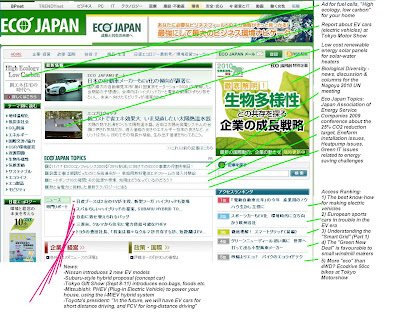
This is something I wanted to do for a long time: a quick rundown on what's considered as news at Japan's leading news website for eco topics. Nikkei is the big news paper devoted to economic issues, and their Eco Japan website reflects some of that focus. It's not going to give you the small-scale, happy-go-lucky news or information about grass-root events that you usually see here on Kurashi. Yet, I think it highlights what corporate Japan Inc. is thinking these days, to a large degree. Tech-On! has more stories in English. Plus, of course, Japan Inc. has some 70% of the patents to back up their claim to the No 1 spot: The Japan Patent Office conducted a survey on trends in global patent applications related to electric vehicles (EVs) and other "electric propulsion vehicles" and announced that about 70% of the applications were filed by Japanese applicants. Electric propulsion vehicles include EVs, hybrid electric vehicles (HEVs) and fuel cell vehicles (FCVs)...

Awesome: Chugoku Electric To Pay Double If You Have Solar Panels

I don't use the word "awesome" very often but that's how I felt when I read Hiroshima Gab brag about how her power company has decided to increase the payment to users with PV solar panels from 26 yen to 48 yen per kilowatt of solar power. Yes, instead of paying money to the power company, you get paid by them. Nice and simple. Hiroshima Gab explains how it works: This works great for us as we are usually gone during the day so that we sell more of our solar made power during peak rate daylight hours (bought by the electric company and sold again/used by our neighbors), and use it at night when it is cheaper (8pm-8am). We have had the PV panels on our home for just over a year now and on average we have received more money back from the electric company than we have paid on average each month. Peak months in spring and autumn, we end up getting back about 4-5,000 more than we pay, but once the new rates go into effect we will be getting a lot more money back each m...

Total Eclipse Of The Sun Today In Asia

A string of countries in Asia are experiencing a total eclipse of the sun today Wednesday. Here in Japan, the spectacular eclipse will be visible from Akusekijima Island for 6 minutes and 25 seconds from 10:53 AM, local time. It is actually the longest total solar eclipse visible from any inhabited area of the world this century, according to NHK World and other media. The eclipse started in India, and followed a track across China and Japan. It has gotten a lot of attention as it is the first total solar eclipse in Japan in forty-six years: At the moment of total eclipse, the sky is dark, except for the sun appearing as a very bright ring around the outline of the moon, providing what is known as the ‘diamond ring’. We can subsequently get dramatic views of the corona ringing the sun. The sun is the source of life on this planet. A total eclipse abruptly deprives us of its light and warmth. The sun appears dark and there is a sudden drop in temperature. It is an event which plunges t...