Posts

Showing posts with the label Universe

Jupiter and Moon

Image
Cool view of the sky, I like that I can find out what that bright thing near the moon is - Jupiter. Ken E is invited to join the new Kurashi Experience. Earthsky says: Jupiter’s four major moons – Io, Europa, Ganymede and Callisto – made it possible for math-savvy astronomers to compute the mass (heaviness) of Jupiter. This giant world has the mass of 318 Earths. How do astronomers know the mass of Jupiter? As darkness falls on May 14, 2016, use the moon to find the king planet Jupiter. Watch for them. They will be a sight to see in your sky on Saturday evening. And soon gone far, far away again. You'll also see Saturn and Mars in May!

Jupiter, Moon...

Image
...watch for that bright planet next to the Moon, that's Jupiter. With binoculars, your can see at least four of Jupiter's moons. Ancient Babylonian astronomers used calculus to find Jupiter 1,400 years before Europeans ABC Science By Stuart Gary Updated 29 Jan 2016 Ancient Babylonians Tracked Jupiter With Calculus Jan 29, 2016 The earliest known examples of mathematical and geometric astronomy have been identified in a series of ancient Babylonian cuneiform tablets. An analysis of the tablets, reported in the journal Science, reveals ancient Babylonians were able to calculate the position of Jupiter using geometric techniques previously believed to have been first used some 1,400 years later in 14th century Europe. “These texts are the earliest evidence we have from antiquity of mathematical astronomy,” said the study’s author Dr Mathieu Os...

Miyazawa Kenji - An Introduction

Image
Do visit the Japan Organic Agriculture Association event on Friday, July 25, 2014 to learn more about Miyazawa Kenji . Poet, writer, vegetarian, and more. From Iwate prefecture. And he is well known in Japan and around the world for his essays on wilderness, and the universe, how hard it is to be human, and the wonders of nature. Night of the Milky Way Railway and Other Stories This collection of timeless children's classics by Japan's most beloved modern-age writer features Ginga tetsudo no yoru  (tr.  Night of the Milky Way Railway ), Miyazawa's most celebrated work. It is a story about Giovanni, a schoolboy, and his friend Campanella, and their voyage across the Milky Way aboard a night train. One evening while stargazing, Giovanni hears a voice: "Milky Way Station!" The next moment he is on a train speeding through the galaxy with Campanella. Outside their windows the boys can see a shimmering, phosphorescent river of stars. On the train they me...

Finding Jupiter

Image
Unusually, we can see Jupiter with the bare eye. Clear sky, late night, just above left to Orion. And if you can't find Orion, I'd say you are seriously planet-inhibited. As in having no clue about our position with regards to major planetary bodies. Tycho Brahe and then Newton and others did us the favour of doing the math... So, do go out, late at night, cover one of your eyes for a couple of minutes to avoid light pollution, if that is that case. Try to find a dark spot. Stand there for a while. Finding Orion should be easy. Three stars to the south. Above that to the upper left, you have Jupiter. Rarely do we get to see the guru planet. Only now in January. Great view. If you have better ways of viewing, you may see Jupiter's moons. Imagine how people in the past where amazed noticing that Earth was not the only planetary mass with objects revolving around it. http://earthsky.org/astronomy-essentials/visible-planets-tonight-mars-jupiter-venus-saturn-mercur...

Climbing Mt. Fuji At Night?

Image
Great photo by Hideki Domoto, who ...set his camera’s exposure time at 15 minutes, enabling the camera to capture the movement of the stars. The photo shows the stars as circles in the night sky with the polar star at the center. At the far left of the mountain, one of shooting stars of the Perseid meteor shower leaves a trace of light. From The-Japan-News.com

Misia - Ginkado

Image
Misia and the National Astronomical Observatory of Japan ( NAOJ ) collaborated making this amazing music video. Star Party (E)   Here is a door to the universe.   Star Party for the public is held at the Mitaka Campus of the National Astronomical Observatory of Japan, on Friday before the 2nd Saturday and the 4th Saturday in every month.  (Please check the Star Party Calendar ). Even city lights have taken dark nights away, the universe is still above us. Now it's time to explore the vast universe. A telescope enables us to observe a fine pattern and faint stars thanks to its large aperture. As you know, main roles of telescopes are to collect light and to magnify distant objects. As for concentration of light, larger mirrors or lenses telescope have, more light they can collect. A human pupils has a diameter of about 7mm, while our telescope has a main mirror 50 cm in diameter. The power of collecting light for our telescop...

The Comet

Image
Nice video animation by the good people over at NAOJ (E) of the path of the comet that we will possibly be able to see, in the western sky, just after sunset. I think this is using Mitaka , a cool space visualization program that was developed by Kato Tsunehiko. Stars within 3000 light years with distance measurements from the Hipparcos satellite are in the database... Great photo courtesy Luis Argerich in Argentina. Tricky to catch since it is so close to the horizon. Earthsky provides this helpful image. And did you know that you should be able to see at least five planets this month? You’ll have absolutely no trouble spotting the dazzling planet Jupiter this month, which pops out high into the sky at evening dusk. The king planet ranks as the fourth-brightest celestial body to light up the heavens, after sun, moon and the planet Venus. However, Venus will be obscured in the glare of sun all this month. Look for the moon to pass close to Jupiter on March 16 , 17 a...

Ancient Navigation, Viking Style

Image
We know precious little about how our ancestors travelled. We do know that the Vikings used some kind of "Sunstone" to sail, and recent discoveries seem to confirm that they may have used a kind of crystal found in Iceland and other places in Scandinavia, called spar or Iceland spar or silfurberg . Fältspar is a common Swedish word, so this is not an unusual stone, and not a precious stone as such, but they simply may give a hint at where the sun may be on a cloudy day through polarization. We know of course that vikings like Leif Eriksson settled on the eastern coast of North America (called Vinland by the Scandinavians) long before that upstart Columbus reached what we now call the "American" continent, but it hasn't been clear how the vikings navigated, except for the few lines in ancient Nordic texts . Viking legends, including an Icelandic saga ‘Rauðúlfs þáttr’ with  the hero Sigurður , hint that these sailors had another navigational aid at th...

5 Planets On Show

Image
It snowed a lot today in the Tokyo region, according to the news with over 300 traffic accidents and 15 injuries so far. Most people are not used to extreme weather conditions, and not prepared. We got about 20 cm here northwest of the capital which is the most I have experienced since moving here. National Geographics cites a fresh report that may explain the unstable weather conditions - could it be due to melting ice in the Arctic: Some scientists have speculated that such harsh winters might be a result of disappearing Arctic sea ice, which reached a record low in 2007 due to global warming, according to the U.S. National Snow and Ice Data Center. To test that theory, scientists entered data about Arctic sea ice and sea-surface temperatures into a climate model created by the U.S. National Center for Atmospheric Research. The results pinpointed two mechanisms for how a decline in sea ice could lead to more snowfall. For one, major sea ice loss could alter how air circul...

Full Moon Halo

Image
I noticed an unusual halo around the full moon earlier tonight. It looked much like this: From The Astronomy Photo Of The Day: This fairly common sight occurs when high thin clouds containing millions of tiny ice crystals cover much of the sky. Each ice crystal acts like a miniature lens. Because most of the crystals have a similar elongated hexagonal shape, light entering one crystal face and exiting through the opposing face refracts 22 degrees, which corresponds to the radius of the Moon Halo. A similar Sun Halo may be visible during the day. Pure Land had this to say in January about the moon: When you move from the city into the country, a considerable number of municipally peripheral things suddenly come into your life in a big way, such as the moon and the stars. Also insects, trees and animals, not to mention the sky as a whole. As well general vegetation, and a welcome absence of the masses of concrete and asphalt and people that characterize city life, as do power and phone ...

Milky Way

Image
Have you ever looked up in the night sky and seen the Milky Way? I was watching a few videos on YouTube and it suddenly dawned on me (excuse the pun) that most people have never actually seen the stars, as the "light pollution" totally blocks the view. Here are a couple of videos of what our night sky really looks like, if we don't have city lights shining all the time, and no "light pollution" to obscure the beautiful view (this is what the ancients would have seen all the time, no wonder they had amazing stories about the universe). I liked some of the comments: Yep. It's also known as "light pollution", whereas light in urban areas actually ends up shining outward, towards the sky, rather than downwards, where it's needed. This obscures almost all the stars visible from Earth. It's actually quite difficult to get shots like this. You need absolute darkness, no moon, and you need to be there when the Milky Way actually "rises" ...

Zen Peace & Korea (Old Story)

Zen Peace When a rebel army swept into a town in Korea, all the monks of the Zen temple fled except for the abbot. The general came into the temple and was annoyed that the abbot did not receive him with respect. “Don't you know,” he shouted, “that you are looking at a man who can run you through without blinking?” “And you,” replied the abbot strongly, “are looking at a man who can be run through without blinking!” The general stared at him, then made a bow and retired. from Trevor Leggett The Tiger's Cave Routledge & Kegan Paul, London (1977), p. 160 If you like Kurashi, use it as a tool, and use the Internet links to find what you are looking for. Stop reading what is not helpful for you. Thank you for reading Kurashi.

Finding Jupiter, Uranus - And Orion

Image
Very clear sky tonight, with some thunder and lightning back over in the Chichibu mountains. Wish we would get some rains. It is rather hot this summer, is it not? Which means, taking a walk at night is such a pleasure. Thanks to P , I was made aware of the fact that you can easily spot Jupiter, that huge planet, as it emerges in the night sky near the full moon. He even suggested that it is possible to see a moon or two, using binoculars. I was reminded of how much effort people in the past put into carefully noting such events. Tycho Brahe , a Dane living on the tiny island called Hven or Ven between Denmark and Sweden, near Malmö and east of Copenhagen, made many of the observations that were later used by greater minds to help us all make sense of the universe. Uranienborg, "The Castle of Urania" was his star observatory, and he also tried to impose farming methods, inspired by his travels, such as his journey to the botanical garden in Padua that Tycho probably visited ...

Tokunoshima Island - Shima No Uta

Beautiful slideshow from Tokunoshima Island with music by Rimi Natsukawa: Shima No Uta (Island Song). This is a small island in the south part of Kagoshima prefecture, as near to Okinawa as you can get. Calling this a "relocation" from Okinawa is a joke. A rude, cruel joke. Contrast that with the amazing scenery, the lovely sea, the beaches and the wildlife and biodiversity - and the people. This is another island in Asia that does not need US military helicopters or Marines. Asahi: Tokunoshima eyed for U.S. helicopters More than 4,000 people attended a rally on Tokunoshima island in Kagoshima Prefecture on Sunday to protest its possible use as a relocation site for some of the functions of the U.S. Marine Corps Air Station Futenma in Ginowan, Okinawa Prefecture. Sources said Tokunoshima was mentioned by Foreign Minister Katsuya Okada and Defense Minister Toshimi Kitazawa in their respective discussions Friday with U.S. and Okinawa prefectural government officials in wh...

Shunbun - Spring Equinox Holiday

Image
Spring Equinox is a holiday in Japan. It fell on Saturday this year, so Monday is a substitute day off. Congratulations, you all deserve it. Known as 春分 (shunbun, vernal equinox) this is an ancient time to take note of the change of the seasons. When we talk about climate change or global warming, perhaps we ought to pay more attention to how the seasons and the climate had deep and profound implications for farmers and everyone. They paid much more attention to the stars and the planets than we do today. It made a difference, as they had to plant seeds and plan trips and sail according to the warm winds. Living closely attuned to the seasons was the key to survival for people since ancient times. In Asia, the calendars used to be lunisolar, meaning the cycles of the moon and the sun where both taken into consideration. For farmers in Japan, this calendar was also helpful as a guide to remember what to expect next. The principal method of telling time is actually rather easy. The day i...

Winter Solstice In Japan: Yuzu Bath, O-Mochi, And More

Image
Today is the shortest day of the year, as the planet tilts away from the sun and we have winter solstice here on the northern hemisphere. It is called 冬至 (tōji) and the same kanji are traditionally used in China, Korea and Vietnam as well. More details on wikipedia for Dongzhi Festival . In Korea they serve a special dish with rice dumplings and red azuki beans, on this day. It is called Dongji Patjuk, and Food in Korea has more details: While making Patjuk as a seasonal food, they put pieces of glutinous rice cake shaped as a bird's egg, which has honey inside. This food also goes on the table for the memorial service and is often thrown into the door as a gesture to drive away misfortunes. On Dongji, each family make Patjuk to eat, and this is made by the process of mashing boiled red-beans or ...

Surprising Kanji Lesson: Hotoke, Butsu (Buddha)

Image
The Japanese kanji for Buddha is a simple 仏 (hotoke) - a simplified version of the Chinese 佛, which is also common here. How did this character appear? I was reading an essay on Sacred Texts , a great website, when I found one explanation that I had never heard before. The essay is The Creed of Half Japan , by British Reverend Arthur Lloyd, who spent more than a quarter century as a lecturer at the Naval Academy in Tokyo. This particular book was published in London in 1911. He notes that Nestorian Christians had made inroads in China some 1500 years ago. Did they influence the Chinese Buddhists? Rev. Lloyd clearly thinks so. The Nestorians brought ideas about Jesus and his teachings to the East, and there are records of at least two Nestorians reaching Nara in the 8th Century, all the way from Persia, Syria (or Turkey). Around exactly that time, Rev. Lloyd notes, Japan started caring for the sick in a new fashion, and there are other examples of how Christian ideas may have influence...

Perseid Shower Tonight

Image
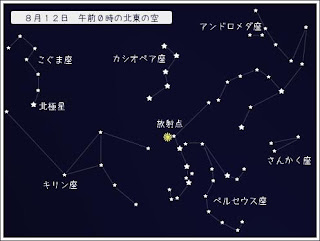
There is a very good chance to see meteors tonight, if the sky is clear. The Perseid meteor shower has been observed regularly for a very long time, and was first noted in the "Far East" (don't you just love the old-fashioned term!). The shower is visible from mid-July each year, with the greatest activity between August 8 and 14, peaking about August 12. During the peak, the rate of meteors reaches 60 or more per hour. - Wikipedia Image from hoshifuru.jp who notes that the peak will be around 2-3 AM on August 13 here in Japan. Look towards north-east. 流れ星 (nagare boshi) is the Japanese word for falling star, while meteor is called 流星 (ryuusei). 星 (hoshi or -boshi or -sei) is of course "star" so I was surprised to see that kanji in the proper word for meteor, as they are not stars at all. What Wikipedia means by "Far East" is more clear from the link to meteorshoweronline.com : The earliest record of Perseid activity comes from the Chinese annals, whe...

Total Eclipse Of The Sun Today In Asia

A string of countries in Asia are experiencing a total eclipse of the sun today Wednesday. Here in Japan, the spectacular eclipse will be visible from Akusekijima Island for 6 minutes and 25 seconds from 10:53 AM, local time. It is actually the longest total solar eclipse visible from any inhabited area of the world this century, according to NHK World and other media. The eclipse started in India, and followed a track across China and Japan. It has gotten a lot of attention as it is the first total solar eclipse in Japan in forty-six years: At the moment of total eclipse, the sky is dark, except for the sun appearing as a very bright ring around the outline of the moon, providing what is known as the ‘diamond ring’. We can subsequently get dramatic views of the corona ringing the sun. The sun is the source of life on this planet. A total eclipse abruptly deprives us of its light and warmth. The sun appears dark and there is a sudden drop in temperature. It is an event which plunges t...

Solar Eclipse Seen From Kaguya

Image
On February 10, Japan’s Kaguya lunar explorer shot these photos, and high resolution video (actually a NHK HDTV camera) of the Sun hidden by the Moon - or is it Earth? This effect is called Baily's beads, in honour of Francis Baily , who first provided an exact explanation of the phenomenon in 1836. Found on Pink Tentacle