Posts

Showing posts with the label zero waste

Permaculture, A Story

I have been hearing good things about permaculture but I'm less inclined to agree that animal husbandry can be integrated in any such endeavor... Ken sayz… Personally for me permaculture is about just enough and finding contentment, not exerting energy to make money. I like that it’s focused on rebuilding the top soil and growing perennials and growing food and transforming yards into useful spaces, making everything have multiple functions. To me permaculture is not just about making it in the current economy, it’s about planning for a future economy after unsustainable practices fail and leave us with nothing but the more sustainable ones, which is something that I think young adults today will see as they grow old. Which made me come up this story, or parable, or fable, of our times: Once upon a time... there was a city boy in his early thirties who moved to the hills to farm with his young wife. They started small and that all went well for a while. Th...

3R: Reduce, Reduce, Reduce

Image
Some 30-20 years ago, environmental groups in the US and Europe like Greenpeace and Friends of the Earth attracted a lot of talent, people who wrote great reports and participated as non-governmental organizations at UN meetings about global matters, in addition to staging demos at sea and climbing chimneys and so on and so forth. What if we had not had those dedicated people? The world would have been a lot more dull. Some of us decided to work directly for people, for consumers. One of the great ideas back then was the concept of 3R* which is now mostly forgotten. If you know what 3R means, well done. The rest of you will have to fact check at the end of this blog post. 3R was a way of communicating the dire state we were in, some 20 years ago. We still have not learnt much. Thus, it seems to me that we are left with an entirely new 3R: Reduce consumption, Reduce waste, and Reduce ecological foot print... Reduce is of course an idea that goes 180 degrees against the common econ...

Updates From Hyderabad, From Consumers Union Of Japan

Image
Oh, I just could not resist. "Hyderabad" sounds just terrific, it is somewhere in India, and I'm sure all my long-suffering Kurashi readers cannot wait to hear what this is all about. The Convention for Biological Diversity. 2 years ago it was held in Nagoya, and in 2014 it will be hosted in South Korea. Hyderabad, like Nagoya, are places that are trying to rise to the occasion.  Japan, India, South Korea... We are in the right spot for United Nations conferences. This CBD is one I am particularly interested in, as it attempts to deal with biological diversity, and that included all kinds of important issues about food and food safety. I hope Asia can do better. My own personal concern was always food - we eat some plants and rely on the farmers to save seeds. We need a lot of variety of seeds to keep our main foods healthy, and make sure that they are easy to grow. Some of the seeds may not be commercially interesting, but they still need to be farmed or kept growi...

What To Do About Nuclear Waste?

Image
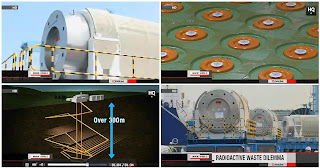
There are questions and then there are questions... What to do about nuclear waste, that will stay dangerously radioactive for tens of thousands of years, is one such question, that neither science nor religion nor anything else seem to provide answers for. Heck, we don't even know what the pyramids in Egypt actually mean. Were they built to tell us something, or just made to impress? Japan has no solution to the big question about nuclear waste. The 54 nuclear plants, that are now mostly idle, were built to provide cheap electricity. No concern about the long-term disposal was OK as long as scientists and government officials agreed to not ask the difficult question: what to do about radioactive waste in an earthquake-prone country. Now, a report is about to be released that questions that mentality. NHK World reports: Japan's national scientists' organization is to propose a radical review of the government's plan for disposing of highly radioactive nuclear ...

Non-Electric Lifestyle

Image
A clever inventor in Nasu, Tochigi prefecture is thinking about how to live a non-electric lifestyle - and doing something about it. Yasuyuki Fujimura, with a PhD in engineering, makes products that don't run on electricity, including this fascinatingly simple refrigerator. Japan for Sustainability explains: How can it refrigerate food without electric power? It uses a phenomenon called radiational cooling together with the natural convection currents of water. Radiational cooling occurs when infrared radiation is emitted from an object's surface, causing its temperature to decrease. On a clear night, infrared rays are emitted from the ground into the atmosphere, cooling the air down. This is why the night is extremely cold in the desert. Most people have experienced water's natural convection currents when warm water rises while cold water sinks and pools at the lowest level. The cooling unit of the refrigerator (capacity 200 liters) is made of metal that has high thermal...

Huge Anti-Nuclear Demonstration In Tokyo

Image
Some 60,000 people gathered in Tokyo on Sept. 19 to raise their voices and to call for abolishment of all nuclear power plants in Japan. This was one of the largest rallies Japan has ever seen in its history. Japanese Nobel laureate, Kenzaburo Oe, said in his speech that humans cannot co-exist with nuclear energy in its state and a demonstration is a means for the public to show its dissatisfaction in government policies. 10 minutes video Reported by Chie Matsumoto Filmed by Akira Matsubara Thanks to Ten Thousand Things for posting. The Mainichi has published an essay by Oe that I think catches his mood perfectly. He seems to always weigh his words carefully, more carefully than any writer I have ever known. Each word, such as "outrage" or "waste" seems to matter immensely to Oe. A good lesson for all of us. Kenzaburo Oe: Resignation to and responsibility for Fukushima disaster It hasn't been long since I read a science fiction piece in which humankind decides t...

The Good Life

Image
Food and energy, energy and food. And some humour. Then we're happy, basically. Here is an episode from the UK comedy show The Good Life, in which Tom and Barbara deal with self sufficiency by turning pig manure into methane gas, that can be used to produce elctricity. From their basement. Using a very dodgy machine. But it works. Happy 1970s when this kind of show could be made for the masses. If we don't get food and energy (and humour)? Well, people tend to protest, complain, suffer. We really are rather spoiled. I think I prefer trying to do something about my situation, rather than blaming others. Not easy, but infinitely more fun.

The Big "0"

Not the letter O, I mean "ZERO" - as in zero waste. A small town of 2,000 people has started down an ambitious path to 100% zero waste - Kamikatsu, in Shikoku Region's Tokushima Prefecture. So far, the town has increased its recycling and composting rate to 80 percent. As a result of Kamikatsu's lead, at least two municipalities have made a zero waste declaration - Minamata City in Kumamoto Prefecture, and Oki town in Fukuoka Prefecture. In addition, Hayama town in Kanagawa Prefecture has adopted a zero waste policy. Let's help this trend catch on in a much bigger way. I like the Mayor's happi coat, recycled from a koinobori (carp streamer). And here is a report about a family in the USA who have a virtually zero waste household. Perhaps not surprisingly, the lady of the house was not originally from the US, but France. This family lives in one of the wealthiest counties of the US, so if they can do it, it can happen anywhere. Visit msnbc.com for breaking ...