Posts

Updates

Image
Here are a couple of updates on Kurashi events over the past few days - things have been busy: Japan said Friday it will accept the draft of an international treaty banning cluster bombs, except for the latest types, and eventually abolish all of those weapons owned by the Self-Defense Forces. The decision, a turnaround from the government's traditional stance, came in response to an agreement on the draft treaty reached in Dublin on Wednesday. The treaty was negotiated by a group of countries, including Norway, supporting a ban under what is known as the Oslo Process. It was formally adopted in Dublin on Friday. Asahi: Japan OKs ban on cluster bombs Nongovernmental organizations on Friday called on the Japanese and African governments to take urgent action to mitigate the food crisis in Africa as well as secure additional resources beyond current aid commitments to deal with the impacts of volatile changes in climate. "The doubling of aid to Africa is a welcoming step in the...

More protests in Seoul

Image
Thousands of South Korean citizens are continuing their candlelight vigils against president Lee's decision to start importing American beef without proper controls, due to concerns about Mad Cow Disease. They are also furious about the Free Trade Agreement with the US and taking to the streets - more protests are expected this weekend. Tens of thousands of citizens and students from more than 1,000 civic groups took to the streets hours after the government officially announced the resumption of U.S. beef imports, which will be available to consumers as early as next week. However, protestors gathered at plazas in front of Seoul City Hall and Cheonggae Square, both of which are in downtown Seoul, holding a candle in one hand and placards criticizing the deal in the other chanting "Nullify the beef deal," "Eat the mad cow yourself Lee Myung-bak," and "Impeachment." The Korea Times: Beef Import Decision Triggers Protests

G8 Environment Ministers meeting in Kobe

Image
Standing in front of Maps of "Japanese environment technologies expanding to the world" as they visit the Environment Fair in Kobe, what where these ministers* really thinking? European and developing countries urged the United States and Japan on Sunday to commit to deep cuts in greenhouse gas emissions by 2020. But all they could agree was to make 50% reductions "by 2050". Wake up guys. That's LATE. Did John F. Kennedy say, "Hey lets put a man on moon by the end of the 21st Century" - No, he said, lets do it by the end of the decade. By setting a tough deadline you get things done. In my opinion, 2050 is not a deadline. They might as well have said, "Sorry, we don't know what to do, we can't agree on anything, and we accept the blame." And then they should have all resigned. Reuters notes that some environmental activists said the ministers had made progress -- but not very much: "We're at the point where there needs...

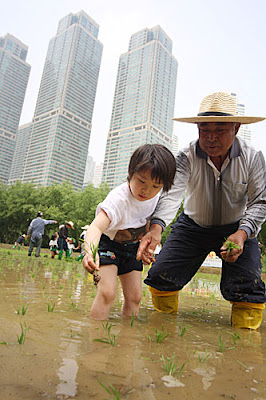
Rice planting in Seoul

Image
The Korea Times has a nice photo special with more photos of the rice planting event in central Seoul this weekend. Go to The Korea Times: Rice Planting in the Heart of the City and click on the link.

Peaceful Japan

Image
View of Wagakuni-san from Sainen-ji, Inada, Kasama City, Ibaraki. The 12th Century monk Shinran Shonin lived here for 20 years and wrote that the mountain reminded him of Mt. Hiei back in Kyoto where he first studied Buddhism. Wagakuni means "our country" - the expression is reserved for Japanese referring to Japan. (click picture to enlarge) Japan has been ranked as the 5th "most peaceful" country on the 2008 Global Peace Index for the second year in a row. Number one was Iceland. The USA ranked 97th, China 67th. Japan was the only G8* country to make the top ten. Top Ten on the Global Peace Index The GPI was founded by Steve Killelea, an Australian IT entrepreneur. The 140 countries examined the 2008 rankings were rated by a panel of experts based on 24 factors, such as a country's relations with its neighbors, percent of its budget that is spent on the military, internal or external wars, violent crime rate, respect for human rights, prison population...

UN talks on cluster bombs in Dublin

Image
I'm hoping the UN talks on cluster bombs will not be stalled by the fact that this country has about 4 different types of them. Japan participates in talks, while the US is not "a party" meaning it does not even want to discuss the issue. China and Russia also do not participate. Why? Any Chinese or Russian reader of this humble blog who would like to shed some light...? Daily reports from the conference here . Countries that "acknowledge they cause unacceptable harm to civilians but seek a transition period to allow them to develop alternatives" are Britain, France, Germany, Japan, Switzerland and Japan in this group. I have no idea why modern democracies in a civilized world still needs cluster bombs or any weapons of mass destruction. Read more: Reuters/IHT: U.N. calls for global cluster bomb ban The Dublin Diplomatic Conference on Cluster Munitions will take place from 19-30 May 2008 in Dublin, Ireland. An earlier article notes that the Pope encourages the c...

"Utter Tragedy"

Here is an opportunity to watch , listen or read Democracy Now's interview with Hans Blix, former Chief UN Weapons Inspector. He also discusses Iran, Israel, and the oil crisis. AMY GOODMAN: And your assessment of the war in Iraq today and what it has done? HANS BLIX: I think it’s an utter tragedy that—what has happened. The US and others expected it would be a short warfare. They expected to find weapons of mass destruction. And it has now gone on for many years, and Iraq is still not at rest. So I think it shows that the military solution was an erroneous one.