Posts

Rice flowers

Image
Late July is the season of rice flowers, the tiny flowers that make the wet rice paddies look sublime around this time of year. With a google search for 米の花 (rice flower) I found a nice blog with photos. Enjoy!

"I've never had better rice than this."

Selling coal to Newcastle is a British idiom describing a foolhardy or pointless action. Well, here in Asia, Japan is now exporting its rice to Chinese (rich) customers at prices 10-20 times the cost of local rice. Yomiuri Shimbun is extatic, and notes that one shopper said, "I've never had better rice than this." Come on, is that journalism? Yomiuri: Japanese rice on Chinese shelves / Koshihikari, Hitomebore back in shops after 4-year ban lifted by Beijing A two-kilogram pack of Koshihikari rice was on sale for 198 yuan (3,200 yen) while a two-kilogram pack of Hitomebore was priced at 188 yuan (3,008 yen). On the other hand, locally grown rice is available for about 8 yuan, less than one-twentieth of the cost of Japanese rice. In China, more than 200 million tons of rice are consumed annually while Japanese only eat about 9 million tons. In urban areas of China, the number of wealthy people have rapidly increased, so experts believe that a potentially huge rice market ex...

Give us our daily genmai...

Image
Living in Japan for a long time, I get to like rice more and more, and for my daily bento lunch box I like to have some 玄米 (genmai or brown rice). Of course I like white Japanese rice too, which is nice and sticky. There are several common varieties with some taste and texture differences, such as the famous one, Koshikihari, and Norin, Sasanishiki, Akitakomachi, Hitomebore and Hinokari. I was surprised to learn that Koshihikari, the most popular "Japanese rice" was first created in 1956, by combining 2 different strains of Norin rice varieties, after research that had started in the 1920s. 30% of all rice that is grown is Japan is Koshihikari, and some 80% are in fact varieties of Koshihikari. It was not until the 1960s and 1970s that machinery becamce common on Japanese farms, so ask any old farmer and I'm sure he (or she) still remembers how to grow the stuff without using fossile fuels, agrichemicals - and a lot of blood, sweat and maybe tears too. Rice research conti...

Beat the heat

Image
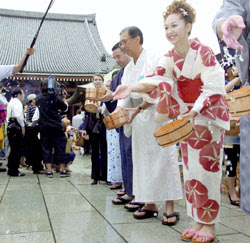
Participants sprinkle water on the ground at Sensoji Temple in Tokyo's Asakusa district Monday in the first of a series of events by citizens' groups to help ease summer heat. The "uchimizu" event will be held at various places, including Osaka and Hiroshima. 31 degrees today in Tokyo, seems the rainy season is ending. (Photo from The Japan Times)

The making of Japanese national cuisine

Image
Katarzyna Cwiertka has written a nice article for Japan Focus about War, Empire and the Making of Japanese National Cuisine . She traces many of today's typical Japanese dishes, such as yakiniku and gyoza, to the experiences of millions of Japanese living on the Asian mainland during WW2 and Koreans remaining in Japan in the post war era. Nice photos too: the hopefulness of the Morinaga bread ad from 1937 juxtaposed with vegetable farming in front of the Parliament building in central Tokyo in 1945... Japanese national cuisine was shaped by a variety of forces that emerged in Japan since the late nineteenth century. However, perhaps surprisingly, militarism stands out as the most powerful. This influence of militarism does not complement the general image of Japanese cuisine, with its strong emphasis on aesthetics of presentation and harmony with nature, and is therefore very little known. I'm not so sure there is such a thing that can easily be defined as "Japanese nation...

CNIC Report on Niigata Earthquake

Image
Citizens' Nuclear Information Center ( CNIC ) has published a report about the Kashiwazaki-Kariwa Earthquake, called Japan's Nuclear Safety Shaken to the Roots Excerpt: From analysis of the distribution of the after shocks from the 16 July 2007 quake, it is now believed that there is an active fault extending directly under the Kashiwazaki-Kariwa NPP. Since Japan's earthquake resistance guidelines do not permit NPPs to be built directly above active faults, Kashiwazaki-Kariwa would not have been chosen to host a NPP had this been known at the time. However, it now appears that this should have been recognized. After the recent earthquake, Professors Takashi Nakata (Hiroshima Institute of Technology) and Yasuhiro Suzuki (Nagoya University) analyzed the data in TEPCO's license application and concluded that it indicated a fault five times longer than one identified by TEPCO (Asahi Shimbun, 20 July 2007). Between 1979 and 1985, using sonic testing, TEPCO found 4 small faul...

Pot calling the kettle "black"

Image
China and the US are in a battle of words regarding food safety, that reminds me of the old adage: The pot is calling the kettle "black"...