Posts

Kamikaze to Croydon at the Tokorozawa Aviation Museum in Saitama

Image
Today, I went to the Aviation Museum in Tokorozawa, Saitama prefecture, to give them a copy of my novel, Kamikaze to Croydon. I bet they were a bit surprised. I had not called ahead, which I should have done, and I have no calling card (meishi) to explain the details of my endeavor. 所沢航空発祥記念館 Tokorozawa Aviation Museum They kindly accepted my book for their library, and we had a lot of laughs. I suggested that they do a more thorough and large exhibition of the 1937 flight. I also mentioned that at Croydon in London, they had a proper display of the arrival, with lots of photos and more, while here in Japan, there is no such thing. Click here, and you can purchase my novel Kamikaze to Croydon on Amazon Iinuma Masaaki is a promising young pilot from the mountains of Nagano, Japan, who only has thoughts of flying for the Morning Sun newspaper. When he learns of a prize for the first aviator to fly from Tokyo to London in under 100 hours, he knows he has the will to...

One Chance for Glory

Image
1931: The first pilot to fly across the Pacific was Clyde Pangborn, and here is a great documentary on Youtube (only about 500 views, how about it). Great film clips from back in the early 1930s. He is remembered in Misawa, Aomori Prefecture in northern Japan, and in Washington State, U.S. For their accomplishment, Pangborn and Herndon were awarded the the White Medal of Merit of the Imperial Aeronautical Society by Consul General Kensuke Horinouchi. The presentation took place at the Japanese consulate on 21 November 1931. The United States National Aeronautic Association awarded the two men its 1931 National Harmony Trophy. And here is a novel that tells the story. One Chance for Glory by Edward (Ted) Heikell and Robert (Bob) Heikel, both from Washington State, U.S. Synopsis Pangborn flew 4500 miles over water in a Single Engine Land airplane, jettisoned his landing gear into the ocean to save drag, climbed outside at 17,000 feet in the frigid ai...

So, Who Was The First To Fly Across The Pacific Ocean?

Image
Quiz time - we all know the name of Charles Lindbergh flying from the US to Europe in 1927. Many other flight records were as important, but who did the first flight across the Pacific Ocean? What sets Lindbergh's record apart is that it was a solo flight. Not particularly useful, but in that day an age, it caught the attention of the general public and the media. More realistically, a pilot needed a navigator, as in my novel, Kamikaze to Croydon. Breaking the record and flying from Japan to Europe in just four days in 1937 could not be done solo. American Wiley Post and Harold Gatty did the first round-the-world flight in 1930, after the German Graf Zeppelin, piloted by Hugo Eckener had pioneered that particular feat (including a landing in Japan). Canadian pilot Harald Bromly was the first to make a serious attempt at the Pacific, but failed when starting from Tacoma, Washington State, U.S. ''I find it difficult to convince many persons that this proposed flight...

Tokyo Yamanote Line Melodies

Image
If you have ever been to Tokyo, you must have taken the Yamanote Line around town. Here are the melodies for the different stations. Sometimes, when I have an hour to spare, I take the Yamanote Line one way around, but I do hate the recent all-video trains. Let's keep the stress level down, shall we. Please, less ads, more train pleasure. Still, the JR East Yamanote Line has to be the best service around.

Toru Takemitsu - L.A., New York, Paris, Rome, Helsinki (1991)

Image
The wonderful things that happen. Or not. In 1991, Japanese composer Toru Takemitsu was invited by American director Jim Jarmusch to write the original music for his film "Night on Earth", but his finished work was subsequently rejected by the director. The supposedly lost music by Takemitsu was aptly titled “L.A., New York, Paris, Rome, Helsinki” - five cities featured in Jarmusch’s film.

New Photos From Croydon

Image
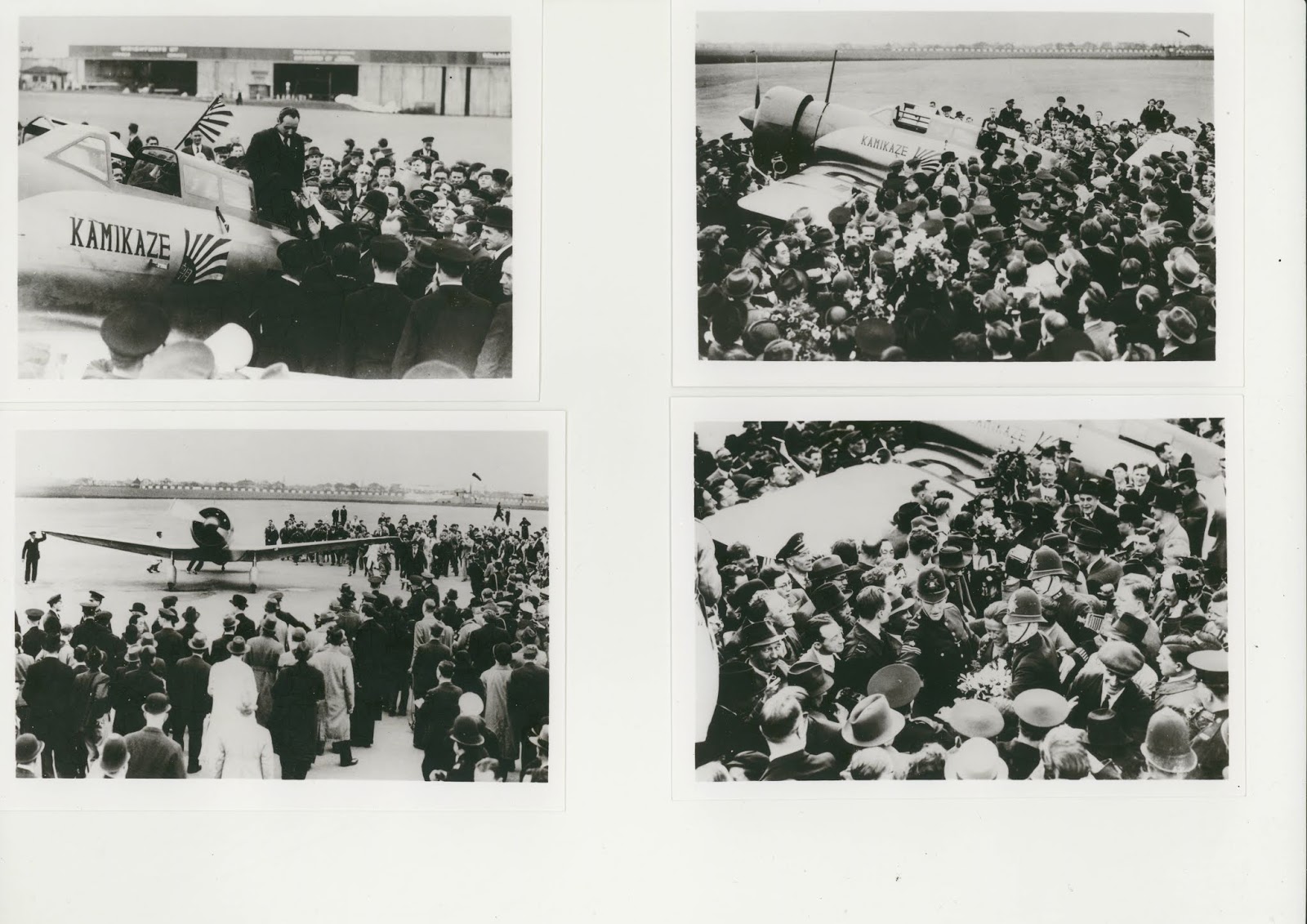
Amazing images from April, 1937 as the Kamikaze-go landed at Croydon, London. From my new friends at the HCAT Archives, Peter Skinner and Ian Forsyth. Record breaking flight from Tokyo. Can you spot Tsukagoshi climbing out of the airplane in the first picture? That's the easy one. Finding Iinuma in the last image may be more difficult, what with all the London policemen escorting him. He smiles a lot, holding on to a bunch of flowers, and is rather sun burnt from the long flight over the desert. Don't you think he was the happiest man on earth, that day. It inspired my wish to write about his long flight from Japan to Europe. And you can order my novel about it here, Kamikaze to Croydon . Bonus image: I took this photo of Iinuma Masaaki's pilot licence at his museum in Nagano:

WW1 Pilot Harry Ohara Remembered

Image
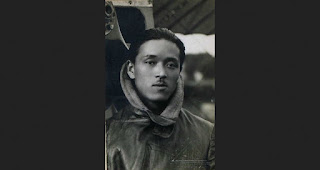
First time I heard of this guy and his great story. Harry Ohara was born in Japan, studied at Waseda University in Tokyo, went to British India and worked for a newspaper. When war broke out, he joined the British Army. Later he flew after having started as a mechanic. Kyodo notes that he is thought to be the Royal Air Force's first - and only - Japanese pilot: O'Hara applied to become a pilot at exactly the right time, according to RAF Museum curator Peter Devitt. A portrait of an intense looking O'Hara stands out among the heroes -- the only Asian among the portraits -- that decorate the wall at the RAF Museum. More details at the Great War London blog , that notes (correctly) that he must have been flying for the Royal Flight Corps, not the RAF (RAF was formed on 1 April 1918): In March 1917, O’Hara transferred to the RFC as a 2nd-class air mechanic (the basic rank for RFC men – equivalent to his rank of private in the Middlesex Regiment).  He was soon ...