Posts

Toshiba Refuses To Meet Finnish Nuclear Protesters
Image
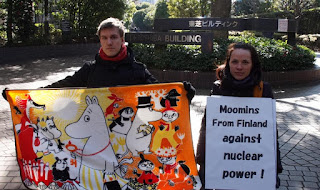
During a demonstration today outside Toshiba's headquarters in Tokyo, anti-nuclear activists pointed out that they had "politely" asked for a meeting with the Japanese company, but were refused without any explanations. Toshiba was selected in October, 2012 to build a new nuclear power plant in northern Finland. However, after protests intensified, E.On, the largest stakeholder in energy utility Fennovoima pulled out of the project. Prohanhikivi activists photographed by Fredrik Oskarsson. The German energy company E.On intends to pull out of the project aimed at building a nuclear power plant in Pyhäjoki on Finland’s west coast. As E.On would have been the largest single investor with a 34 per cent holding in Fennovoima, the company that plans to build the reactor, the whole project is in serious jeopardy. Two other companies, the meat processing company Atria and the S-Group retail chain announced earlier that they were divesting from Fennovoima. E.On'...

Protests Against Toshiba: "Finland Does Not Want More Nuclear Power"

Image
Activists from northern Finland are in Japan to convey the message that Finnish people do not want a Toshiba nuclear reactor in their neighborhood. Hanna Halmeenpää from Pro Hanhikivi has visited Fukushima Prefecture and is now in Tokyo to talk to anti-nuclear activists and I had the pleasure of meeting her and help interpret for her team. A mother of three, she was rudely awoken by a newspaper article that there would be a nuclear plant in the Baltic Sea nature reserve called Hanhikivi - on her doorstep, literally. This is a beautiful cape that turns out to be host to a large number of migratory birds, a location for breeding birds, and unique natural beauty. E.On, the German energy giant soon found out that they had dropped this project on the wrong doorstep. Through lawsuits, going to Brussels and arguing the case that this is a protected Natura 2000 area, and by an amazing amount of enthusiasm, Hanna and others managed to at least bring the project to a temporary halt. E.On ha...

Film: Yamada, The Samurai of Thailand

Image
Thailand and Japan have links that go way back to the 16th Century, and as Buddhist countries, of course there are deeper bonds that transcend time. Based on a true historic figure during Ayothaya Era, here is a film that depicts the life of Yamada Nagamasa , a Japanese samurai who gained considerable influence in Thailand and became the governor of Nakhon Si Thammarat province in southern Thailand. Yamada Nagamasa lived in the Japanese quarters of Ayutthaya , home to another 1,500 Japanese inhabitants (some estimates run as high as 7,000). The community was called "Ban Yipun" in Thai, and was headed by a Japanese chief nominated by Thai authorities. Yamada was born in Shizuoka prefecture in 1590. Wikipedia has more: The colony was active in trade, particularly in the export of deer-hide to Japan in exchange for Japanese silver and Japanese handicrafts (swords, lacquered boxes, high-quality papers, used by Rembrandt, among others). They were noted by the Dutc...

Tasting Japanese Traditional Vegetarian Cuisine

Image
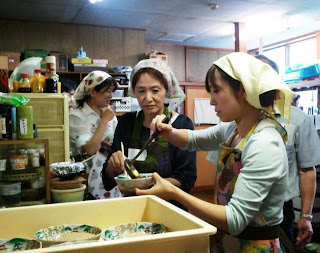
For centuries, Japanese people were mostly vegetarians, with a lot of veggies and grains that were grown seasonally, plus stuff that could be harvested from the wild, like mushrooms or seaweed. Fruit was also plentiful in the southern parts, and even today, I'd say Japan has the most amazing variety of oranges, mikan, dekapon, and so many others in the winter season, providing vitamin C and sweetness during the cold months. This winter, I'm able to harvest several types of greens, including mizuna, hakusai, and sweet cabbage. I'm looking forward to a scale-up of my efforts next winter. Things that I'm still not very good at include broccoli and daikon, staple food in winter as well. I think I will get a hang of it, ultimately. Growing something is what matters, as far as I am concerned, as we are heading towards a time when imports may no longer be taken for granted. Having something from your own garten that you can barter with may make all the difference. It wa...

Art Setouchi Triennale 2013

Image
I am fortunate enough to often get the chance to go to Naoshima and the beautiful Seto Inland Sea, and this year, from March to November, 2013 they are again hosting an event that should attract visitors. Update: As David (merci!) notes in the comment section, the Triennale is held during three sessions: One in the Spring (March 20 - April 21), one in Summer (July 20 - September 1st) and Fall (October 5th - November 4th). Easy access from Okayama. If you have never been to these parts of Japan, you are missing out! First held in 2010, the Art Setouchi is now a much larger, more extended event with events being planned for a large number of locations and islands. Did I mention "events"? List of participating artists here . Setouchi Triennale Website (English) here . You will get stuff like this : Inujima Art House Project: S-Art House An elongated gallery made of transparent acrylic panels appears behind a curve on the road in front of a tangerine or...

Farmers Markets

Image
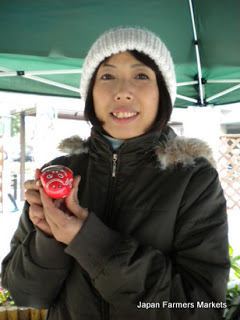
Want to know more about the farmers markets in Tokyo? Want to actually meet a farmer? Most people get their food from supermarkets or the local convenience store, only. How do you feel about that? Head over to the Japan Farmers Markets blog . This weekend should be sunny but cold, so everyone is ready to go. Joan from Michigan, has more: The language may be different, but just under a different culture and maybe a different skin tone beats the same heart. Again and again I find people as generous and kind as any farmer in my home state, as hard-working, as weathered, as cautiously optimistic about the future of their livelihoods. It is, perhaps, how I stay connected with my own culture and history while living so far away. One such farmer is Takako Kimura from Aizu Wakamatsu in Fukushima Prefecture. Takako comes to the Nippori Farmers Market each month with her vegetables, some yummy homemade pickles, and rice. She's charming, knowledgeable, and fun to talk with....

Snow, Trains, Japan

Image
As we got a lot of snow on Monday (a public holiday) I was impressed that most trains kept running. Seibu Ikebukuru Line struggled to get me into Tokyo, and we were 25 minutes delayed, but got the job done. Well done, and much appreciated. While some lines were temporarily suspended, the Yamanote Line managed to keep running all day long. The Yamanote Line is very special for people in central Tokyo. It runs both ways, clockwise and anticlockwise, and a full circle takes just about one hour. This year, it celebrates its 50th anniversary as the first trains started to run the full loop back in 1963, just before the Tokyo Olympics. Sankei notes that the first tracks were laid down back in 1909 between Akabane and Shinagawa, and Ikebukuro and Tabata. Now, in 2013, a campaign to celebrate the anniversary will involve a "Lucky" train wrapped in special green colours. Others trace the history back to 1885 (electrification started in 1909). Current trains are from 2002, built b...